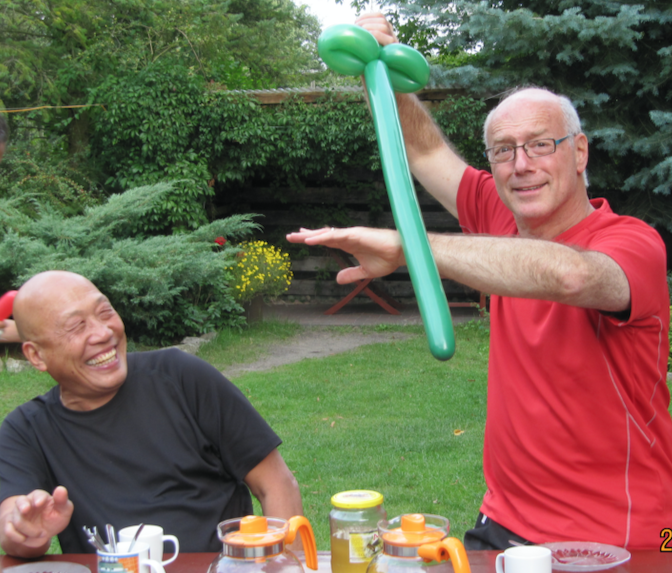
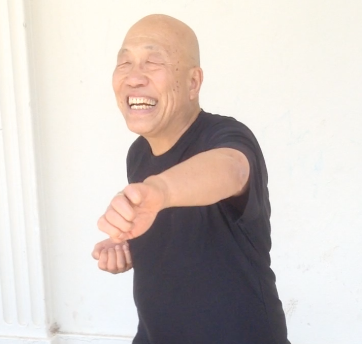
I’ve just heard that my taiji teacher has died. It was a shock: I fully expected to see Howard again. His last text message to me, after I sent a picture of my new taiji saber, was “Good for you, it’ll keep you young.” He wasn’t that old himself: 78. Not particularly old for someone who exercises daily. It’s a sobering thought, and a blow to those of us who knew and liked him.
Howard Choy (Choy Hung in Cantonese) was born in Zhaoqing in southern China in 1947. His family moved to Australia when he was in his teens. He studied architecture and later moved to Hong Kong, where he developed a specialty in feng shui. When I met him, he had been living in Berlin for many years.
My first impression of him was as a calm and dignified older man, very professional. But shortly after we met he told me a story about his younger days. He was dating “the wrong girl”, whatever that means, in Hong Kong. They were out at 4 in the morning when a gang confronted them. I asked if he put his martial arts training to use. He said, “Oh, yeah. I sure did. I grabbed her hand and we ran as fast as we could!” And then he burst out laughing – really loud and raucous laughter.
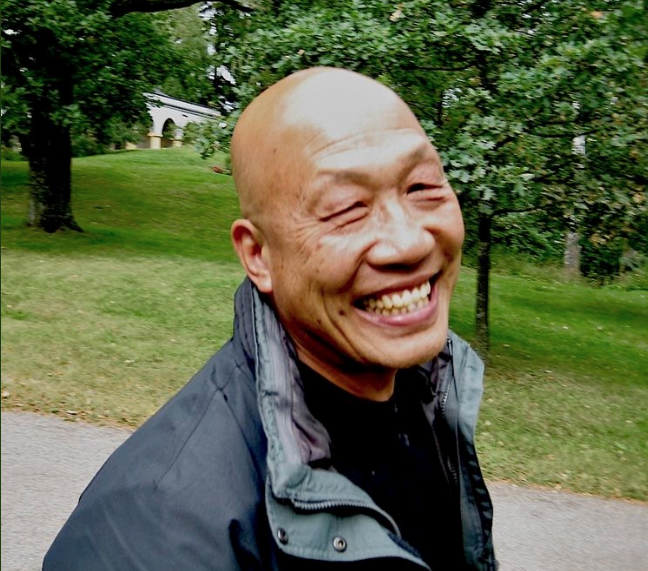
Howard was one of only three people in Europe with a license to teach a particular form of qigong: the Luohan system. It’s quite rare to require a license to teach a sequence of qigong exercises. In theory this should help preserve the art, ensuring that only qualified instructors teach it, without adding anything new or simplifying. But it’s also an example of how the “kung fu families” have monetized their family traditions. About which more later.
The difference between taiji and qigong
Just to be clear, qigong literally means “energy exercise”. There are thousands of different ones. All are intended to help improve health or prevent disease. Two sides of the same coin, but in Chinese medicine prevention is seen as the better option. There are qigong sequences for specific organs: kidney, liver, triple warmer etc. And more general ones just to keep everything running smoothly. Taijiquan (taiji for short) is literally “Great ultimate fist”. When a name ends in “quan – fist”, it denotes a martial art. But taiji is also a qigong: we do taiji for health, as self-defense and ultimately as “cultivation”, meaning it can lead to enlightenment in the Buddhist sense.
The Luohan qigong system belongs to a particular Chen family and its lineage holder is Chen Yongfa, who also happens to be friend of Howard’s.
I had seen some videos of Chen Yongfa doing Luohan qigong. There was something sinuous and elastic in the way he moved. I yearned to be able to move like that. I emailed Howard, thinking he’d assign a student to teach me, but was surprised and pleased when he said he would meet with me himself. We set up some private lessons. The financial side of this was new to me, and amusing. He absolutely refused to name a price. He referred to the tradition of giving one’s teacher a red envelope with some cash in it. The amount didn’t matter.
On the days I trained with him in Berlin, we worked six hours each day, with an hour break for lunch. We often went together to an inexpensive Chinese lunchroom nearby.
He was full of stories. I didn’t know it at the time, but he was connected to some of the greats of taiji. For that matter, he was well-connected in the world of feng shui as well. He didn’t brag, but he had loads of anecdotes about some of these famous taiji people.
For instance, Howard told me about getting Chen Yongfa settled in Sydney. A few of the big names in Chinese martial arts moved to Australia during the Cultural Revolution. China had forbidden martial arts competitions, though taiji for the purpose of exercise was still allowed, as part of China’s cultural patrimony. That restricted what you could teach, however. The whole martial side of the art was threatened. The Chinese government also recognized that a student’s allegiance to his school and his teacher was almost always stronger than that to the party and the country.
Howard found Chen Yongfa a place to live, and arranged to get him married to an Australian student, so that he could get a residence permit. Some time after this Howard got a call from Chen Yongfa’s wife – his wife in China! He had stopped sending remittances home. Did Howard know what was going on? Howard had no idea that Chen Yongfa was already married.
Another anecdote was about Chen Xiaowang. People who are new to taiji are justifiably confused by all the rather similar sounding Chinese names. This is a different Chen family: the originators of one of the main styles of taiji. This particular grandmaster Chen is still the lineage holder of Chen style taiji, and is known and respected throughout the world. He, too, moved to Sydney during the Cultural Revolution, and lived with Howard for two years. During that time they practiced together every morning. Then they often had lunch together, as Howard and I were doing.
We had been talking that day about proper alignment, something he liked to call “verticality”. As an architect he had a great eye for structure. He picked up the ceramic soy sauce bottle and showed me how the top fit into the bottle. The bottom of the stopper had the same shape as the inside of the neck of the bottle, so it always fell to exactly the same spot. He said that Chen Xiaowang showed him this once in a restaurant, and had made the connection to taiji alignment.

Lineage is a big deal for practitioners of Asian martial arts, but Howard insisted it wasn’t as important as it was made out to be. That being said, he had had lessons not just from the current head of the Chen family, but also from an important member of the Yang family. There are basically five family styles of taiji: Chen, Yang, Wu, the other Wu, and Sun. Howard’s first Yang style lessons in Hong Kong were private sessions with Yang Sauchung, Yang Chengfu’s eldest son by his first marriage. So he had the authority that lineage gives, in spades.
But Howard insisted that it was too often just a financial arrangement, in which you give your teacher quite a lot of money and hope to earn it back by charging more for your lessons. Yang Sauchung offered Howard a ‘discipleship’. This would have given him a high status within Yang style taiji. He was invited to pay master Yang US$30,000, and would have been expected to pay a percentage of his earnings from teaching in perpetuity as well. Howard respectfully declined.
Even if lineage has a financial side, it’s also true that one expects to be getting the purest, undiluted version of the art. Did he get the real stuff? He said in an interview that he got the form, but nothing more.
He experienced Yang Sauchung as someone who taught for a living, without too much interest in his students. I’ve written elsewhere about traditional lessons, in which the teacher stands in front and demonstrates. But in Howard’s case he said that his teacher never demonstrated the movements physically. He taught in Mandarin with a heavy accent, told Howard what to do, and then made small corrections in the postures. Howard was really curious about the martial arts applications of the taiji techniques, but he was told he should just look it up in Yang Chengfu’s book on taiji technique and martial applications.
After taking those private lessons in Luohan qigong, I went with Howard to a summer retreat in Poland. He had a big group of students there. It was a workshop in taiji saber and a different qigong sequence, called Yijin Jing. This is the name of a treatise written in 1624 which describes exercises and the process of transforming and improving muscle and connective tissue. We also did taiji every day. On this trip I floated the idea of doing my teacher training with Howard and he agreed to take me on.
On the train back to Berlin after that workshop, we were talking to a German mother and her young daughter. They asked what we had done in Poland, and Howard was explaining about taiji. Just then the conductor slid open the door to our compartment and asked for our tickets. Howard had his on his phone but was told he was supposed to print them as well. When he told the conductor he hadn’t printed his, the young man became a little pushy. He told Howard, “Then I’m going to need to take your passport. I’ll show it to the police when they board at the German border.” Howard smiled in a friendly way and said, “No, you’re not taking my passport”. The conductor was silent a moment, but what could he do? He shut the door and left us.
We all felt like we had just witnessed the “These aren’t the droids you’re looking for” moment from Star Wars. Howard said he had never seen the movie.
The last time I saw Howard in the flesh was at a week-long workshop in Nantes. He was teaching the second of the Luohan qigong sequences. There I asked him about the licensing. I wanted to be able to share the exercises, but had had no luck getting a reply from the mothership in Sydney. I had written to Chen Yongfa’s school a number of times, but they never answered my questions. Howard told me that Chen Yongfa’s children hadn’t gone into the “family business”. They had no interest in qigong and such. And that I should go ahead and teach it. “Otherwise it will be lost,” he said.